Composite Bonding Treatment Hanwell: Benefits, Cost, Procedure
GDC Registered Dentist – CQC Registered – Hanwell Smiles
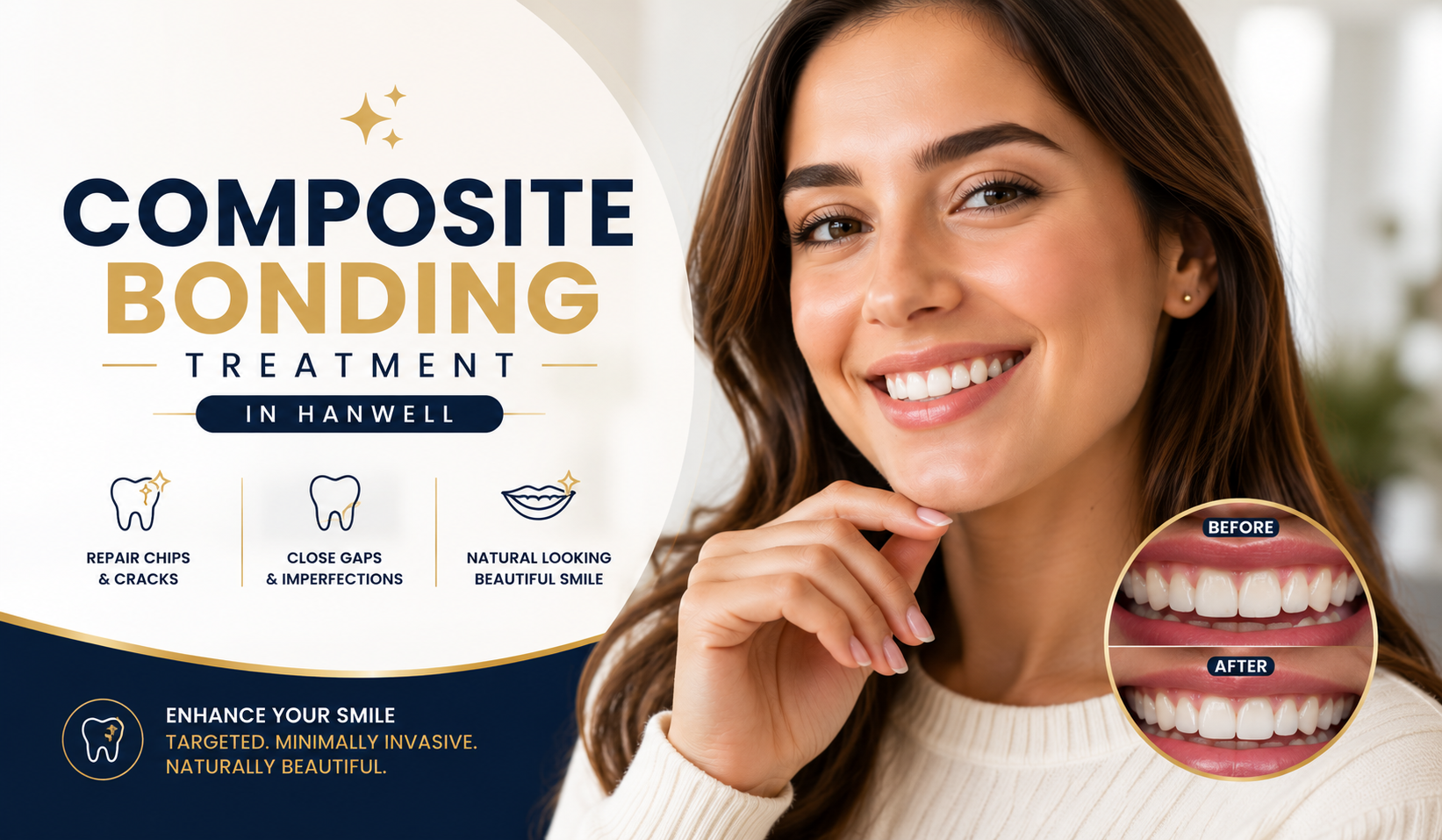
If you’re searching for composite bonding treatment Hanwell, you’re likely dealing with a chipped tooth, an unwanted gap, or a smile that just doesn’t photograph the way you’d like. Composite bonding is one of the fastest, least invasive ways to fix these issues — often in a single visit, with no drilling and no injections. This guide covers what composite bonding treatment costs, how the procedure works, and what results you can realistically expect.
What Is Composite Bonding?
Composite bonding is a cosmetic dental treatment where a tooth-coloured resin is applied directly to the tooth, shaped by hand, and hardened with a curing light. It’s used to close gaps, repair chips, reshape uneven teeth, and cover discolouration — typically in one appointment.
Unlike porcelain veneers, bonding usually requires no removal of natural tooth structure, which makes it fully or largely reversible. It’s often described as the entry point into cosmetic dentistry because it’s quick, affordable, and low-risk compared to more invasive alternatives.
What is Cost of Composite Bonding Treatment Hanwell?
Composite bonding costs in Hanwell Starting From £245 per tooth, with most patients paying £245 per tooth for standard edge bonding. As with the wider London market, pricing depends on how many teeth are treated, whether it’s simple edge bonding or full-coverage work, and the dentist’s experience level.
What affects your final price:
- Number of teeth treated — per-tooth cost often drops slightly for larger cases
- Edge bonding vs. full-coverage bonding — edge repairs cost less than rebuilding an entire tooth surface
- Complexity — closing large gaps or correcting significant discolouration takes more skill and chair time
- Dentist experience — cosmetic specialists with an established portfolio typically charge more than general dentists offering bonding as an add-on service
Composite bonding is a private-only cosmetic treatment and isn’t available on the NHS. Clinically necessary white fillings for decay, by contrast, fall under NHS Band 2 charges, which is a separate treatment category.
What Does the Composite Bonding Procedure Involve?
The composite bonding procedure takes roughly 30–90 minutes per tooth and is completed in a single appointment, from consultation and shade-matching through to the final polish.
A typical session includes:
- Consultation and shade matching — your dentist assesses your teeth, discusses your goals, and selects a composite shade that blends with your natural teeth (around 15 minutes)
- Light tooth preparation — the tooth surface is gently roughened so the resin bonds properly; no drilling or anaesthetic is usually needed
- Layering the composite — resin is applied in thin layers and shaped by hand to achieve the desired contour
- Curing — each layer is hardened using a UV curing light
- Shaping and polishing — the bonded tooth is trimmed, contoured, and polished to match the sheen of surrounding teeth.
Most patients walk out with finished results the same day, and there’s typically little to no downtime or sensitivity afterward.
What Are the Benefits of Composite Bonding?
The main benefits of composite bonding are speed, affordability, and reversibility compared to alternatives like porcelain veneers. Most cases are completed in a single visit with no drilling, no anaesthetic, and next-to-no recovery time.
Key advantages:
- Minimally invasive — little to no removal of natural tooth structure
- Fast — most cases finished in one appointment
- Reversible — can be adjusted, repaired, or removed more easily than veneers
- Affordable — significantly cheaper per tooth than porcelain veneers
- Natural-looking — modern composite resins closely mimic natural enamel translucency
The main trade-off is durability. Composite bonding typically lasts 5–7 years before needing a touch-up or replacement, compared to 10–15 years for porcelain veneers. It’s also more prone to staining over time from coffee, tea, and red wine, so maintenance matters.
Composite Bonding vs. Porcelain Veneers: Which Is Right for You?
Composite bonding is the better choice for minor corrections, tighter budgets, and patients who want a reversible option, while porcelain veneers suit patients seeking a longer-lasting, stain-resistant result for more significant cosmetic changes.
| Factor | Composite Bonding | Porcelain Veneers |
|---|---|---|
| Cost per tooth | £200–£450 | £600–£900+ |
| Tooth preparation | Minimal to none | Requires enamel removal |
| Lifespan | 5–7 years | 10–15 years |
| Reversibility | Largely reversible | Not reversible |
| Appointments needed | Usually 1 | Usually 2–3 |
If you’re unsure which suits your case, a consultation is the only reliable way to know — Composite bonding and Porcelain veneers often solve overlapping problems, but the right choice depends on the condition of your existing teeth.
How Do You Care for Composite Bonding to Make It Last?
Composite bonding lasts longest when you avoid biting hard objects, limit staining foods and drinks, and keep up with regular dental check-ups so any chips or wear are caught early.
Simple habits that extend the life of your bonding:
- Avoid biting nails, pens, or ice
- Cut down on tea, coffee, red wine, and turmeric-heavy foods, which stain composite faster than natural enamel
- Wear a night guard if you grind your teeth
- Attend routine dental check-ups every 6 months so your dentist can spot early wear or staining
- Avoid using your bonded teeth to open packaging
With reasonable care, most patients get the full 5–7 year lifespan — and touch-ups, when needed, are usually quick and inexpensive compared to the original treatment.
Conclusion
Composite bonding offers Hanwell patients a fast, affordable, and largely reversible way to fix chips, gaps, and discolouration — typically in a single visit and without drilling. Hanwell Smiles provide the right consultation, where a dentist can assess your teeth and give you a written, case-specific quote.
FAQ’s:
No. Most composite bonding procedures require no anaesthetic and no drilling, since the treatment adds material to the tooth rather than removing it. Patients typically report mild sensitivity to temperature for a day or two afterward, which settles quickly. If your case involves treating decay first, that separate step may involve local anaesthetic.
A single tooth usually takes 30–90 minutes, and most patients complete their entire treatment — even across several teeth — in one appointment. More complex full-coverage cases or larger smile makeovers may be split across two visits.
In most cases, yes. Because minimal or no natural tooth structure is removed during bonding, the resin can typically be removed or replaced without permanently altering the underlying tooth — unlike porcelain veneers, which require permanent enamel removal.
Yes, when done well. Dentists shade-match the composite resin to your surrounding teeth before applying it, and the material is designed to mimic natural enamel’s translucency. Results can vary based on the dentist’s skill, which is why reviewing a dentist’s specific bonding portfolio matters.
Ready to Book Composite Bonding Appointment in Hanwell
Ready to see what composite bonding could do for your smile? Book a consultation with our Hanwell team today to get a personalised quote and treatment plan.
Get Composite Bonding Treatment Today
Hanwell Smiles — Composite Bonding Treatment in Hanwell.