Dental Hygiene Appointment in Hanwell — What to Expect at Your First Visit
GDC Registered Dentist – CQC Registered – Hanwell Smiles
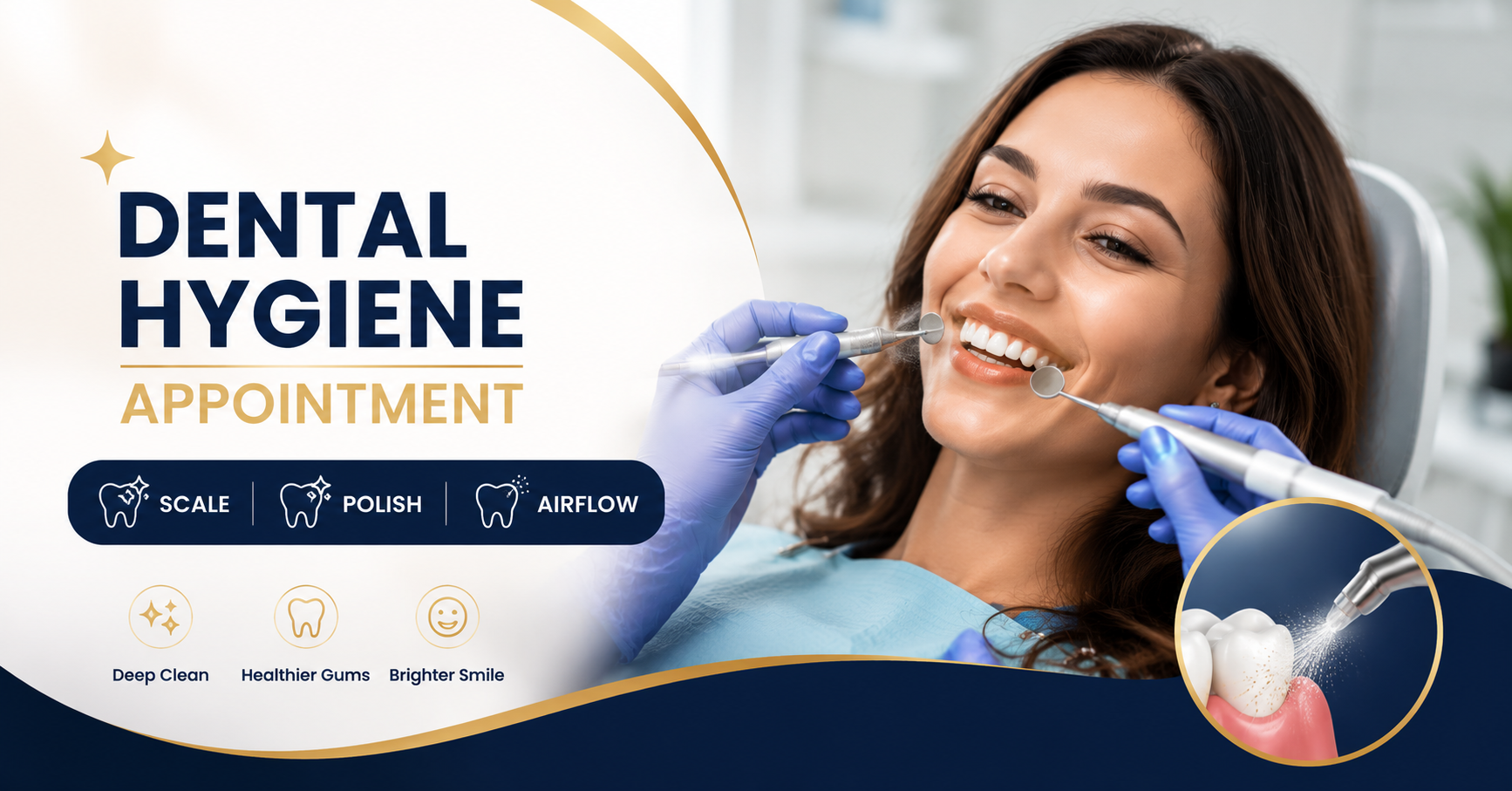
A dental hygiene appointment in Hanwell at Hanwell Smiles takes around 45 to 60 minutes and covers a gum assessment, professional scaling, polishing, and personalised home care advice — all carried out by a GDC-registered hygienist on Uxbridge Road, W7. If it is your first visit, here is exactly what to expect from the moment you arrive.
Most patients feel a mix of uncertainty and mild apprehension before their first hygienist appointment — not because they expect pain, but because they simply do not know what happens. According to the NHS, around 50% of UK adults have some form of gum disease, and the vast majority are unaware until a hygienist identifies it during a routine assessment. Early detection during a scheduled visit is consistently the most effective and least costly way to manage it.
This guide walks you through each stage of a dental hygiene appointment at Hanwell Smiles so you can attend with full confidence.
What Happens at a Dental Hygiene Appointment in Hanwell?
Your appointment follows a consistent clinical sequence: health review, gum assessment with pocket depth measurements, professional cleaning (scaling and polishing or Airflow), and a home care plan. Each step takes roughly 5 to 15 minutes, and your hygienist will explain every stage as they work.
The process is designed around your individual gum health, not a one-size-fits-all clean. Patients with early-stage gingivitis, heavier tartar build-up, or those using Invisalign aligners or dental implants will each receive a slightly different approach — same framework, tailored execution.
Step 1: Health History Review — Why It Comes First
Before any instruments are used, your hygienist will review your medical history, including any medications you are taking and relevant health conditions.
This is a clinical requirement, not a formality. Certain medications — including anticoagulants, antihypertensives, and some antidepressants — can affect how your gums respond to treatment. Conditions such as Type 2 diabetes are strongly associated with more severe periodontal disease, as confirmed by a 2024 consensus study published in the European Federation of Periodontology journal. Knowing your health history allows your hygienist to adapt both the pressure of instruments and the post-appointment care advice they give you.
You will also be asked whether your gums bleed when you brush, whether you have noticed any sensitivity or bad breath, and whether you have been to a hygienist before. These answers directly shape the appointment.
Step 2: Gum Assessment and Pocket Depth Measurements
Your hygienist will use a small instrument called a periodontal probe to gently measure the depth of the pockets between your teeth and gums at six points around each tooth. Healthy pockets measure 1–3mm; readings of 4mm and above indicate inflammation or the beginning of gum disease.
This is the single most important clinical step in the appointment. The numbers are recorded so they can be compared at every future visit — they are your gum health baseline. Many patients have never had this assessment done at a standard NHS check-up, where time constraints mean it is frequently abbreviated or skipped entirely.
What the measurements mean:
- 1–3mm: Healthy gum tissue
- 4mm: Early inflammation; responds well to professional cleaning and improved home care
- 5–6mm: Moderate gingivitis or early periodontitis; may need two hygiene appointments to stabilise
- 7mm+: Active periodontitis; may require specialist periodontal treatment
If your measurements show areas of concern, your hygienist will explain them clearly and recommend the appropriate next step. Early-stage gum disease caught at this appointment is almost always fully reversible with professional cleaning and better home care — unlike periodontitis, which can cause permanent bone loss if left untreated.
Step 3: Professional Cleaning — Scaling, Polishing, and Airflow
Professional cleaning removes the tartar (hardened calculus) and biofilm (bacterial plaque) that daily brushing and flossing cannot shift. Plaque hardens into tartar within 24 to 48 hours of forming, and once it has calcified, only a trained hygienist with specialist instruments can remove it safely.
At Hanwell Smiles, the cleaning method used will be one of the following, based on what your assessment shows:
- Ultrasonic scaling uses a vibrating tip with a water spray to break up stubborn tartar above and just below the gumline. Most patients describe it as a sensation of vibration rather than discomfort — especially effective for heavier build-up.
- Hand scaling uses fine curette instruments to carefully clear calculus from the root surface and between teeth. Often used in combination with ultrasonic scaling for thorough results.
- Airflow cleaning uses a controlled jet of warm water, air, and fine erythritol powder to remove biofilm, surface staining from coffee, tea, and wine, and bacterial deposits around implants and orthodontic appliances. If you have Invisalign aligners, this is the preferred cleaning method as it reaches between aligner attachment points without risk of damage. You can read more about Airflow and how it compares to traditional scaling on our treatments page.
- After scaling, a polishing step — using a rubber cup and prophylaxis paste — removes residual surface staining and leaves enamel smooth, which makes it harder for new plaque to adhere between appointments.
Step 4: Home Care Advice Tailored to Your Teeth
At the end of your appointment, your hygienist will walk through a personalised home care plan based on what they observed during cleaning and the gum assessment.
This is not generic advice. If your measurements showed bleeding in the lower back molars, you will be shown specifically how to clean that area more effectively. If you use a manual toothbrush, they will explain whether an electric brush would benefit you. If your gum pockets are deeper between teeth, you will be shown how to use interdental brushes or a water flosser correctly — both significantly more effective than floss alone for cleaning between teeth, according to a 2023 Cochrane systematic review.
Common recommendations your hygienist may make:
- Interdental brushes in the correct gauge for each gap (the size varies tooth by tooth)
- Electric toothbrush technique — correct angle, pressure, and two-minute duration
- Mouthwash timing — most patients use mouthwash immediately after brushing, which rinses away concentrated fluoride from toothpaste; rinsing at a separate time is more effective
- Dietary advice for patients showing acid erosion or specific staining patterns
If you are a patient currently in Invisalign treatment at Hanwell Smiles, your hygienist will also review your aligner cleaning routine and identify whether any attachment points are harbouring plaque.
How Long Does a First Hygiene Appointment Take at Hanwell Smiles?
A first dental hygiene appointment at Hanwell Smiles typically takes 45 to 60 minutes. Follow-up appointments for patients with straightforward gum health generally take 30 to 45 minutes.
The longer duration for a first visit reflects the additional time spent on your full health history review, baseline pocket depth measurements, and the more detailed home care consultation. It is also common for first-time patients to have slightly more build-up to remove if they have not seen a hygienist for some time — this is not a cause for concern, but it does affect the time required.
Evening and Saturday appointments are available at Hanwell Smiles to accommodate work and family commitments. You can check current availability and book your hygiene appointment online.
Does a Hygiene Appointment Hurt?
A hygiene appointment should not be painful. Most patients describe the sensation as vibration during ultrasonic scaling, mild pressure during pocket probing, and a pleasant lightness from Airflow cleaning.
If you have sensitive gums, inflamed tissue, or a significant amount of tartar below the gumline, you may feel more sensitivity than a patient with consistently healthy gums — this is normal and temporary. Your hygienist will pause and adjust technique at any point if you signal discomfort, and topical anaesthetic gel can be applied for particularly sensitive areas upon request.
Patients who have avoided the hygienist precisely because they are worried about discomfort often describe their first appointment as considerably easier than they expected. The anticipation is almost always worse than the reality.
Conclusion
A dental hygiene appointment in Hanwell at Hanwell Smiles follows a clear clinical sequence: health history, gum assessment, professional cleaning, and home care planning — typically completed in under an hour. It is the most direct preventive step available to protect your teeth and gum health long term, and considerably less involved than most first-time patients expect.
FAQ’s:
No referral is required. You can book a dental hygiene appointment at Hanwell Smiles directly, without needing to see a dentist first. Simply use the online booking form or call 020 7096 3325. If your assessment reveals anything that requires a dentist’s attention, your hygienist will flag it and a referral within the practice takes no additional appointment.
For most adults with broadly healthy gums, every six months is the standard recommendation. Patients with a history of gum disease, those wearing Invisalign, patients with dental implants, and smokers are typically recommended every three to four months to maintain stability. Your hygienist will advise a specific recall interval based on your pocket measurements and individual risk profile at the end of your appointment.
A private dental hygiene appointment at Hanwell Smiles starts from £85. This is a single, fully inclusive fee covering the gum assessment, professional scaling, polishing, and home care consultation. There are no hidden extras. Current pricing and any new patient savings are confirmed at booking — you can view the full fees page for more detail.
Brush your teeth as normal before attending. There is no need to avoid eating or drinking beforehand (unlike before a general anaesthetic). If you have a specific concern — bleeding gums, a sensitive area, or general anxiety — mention it when you book so your hygienist can allow appropriate time and prepare accordingly. Bringing a list of any current medications is also helpful for the health history review.
Yes. A dental examination (check-up) is carried out by a dentist and focuses on diagnosing conditions — checking for decay, oral cancer screening, assessing bite and jaw function, and reviewing X-rays. A hygiene appointment is carried out by a hygienist and focuses on removing what a dentist cannot treat in a check-up: tartar, biofilm, and surface staining. The two appointments complement each other but are clinically distinct. Many patients benefit from booking both in a single visit.
Book Your Dental Hygiene Appointment in Hanwell W7
Evening and weekend appointments available. New patients welcome — no referral needed. GDC-registered dentists and hygienists practising at 114 Uxbridge Road, Hanwell W7 3SU.
Get Dental Hygiene Consultation Today
Hanwell Smiles — Dental Hygienist in Hanwell.