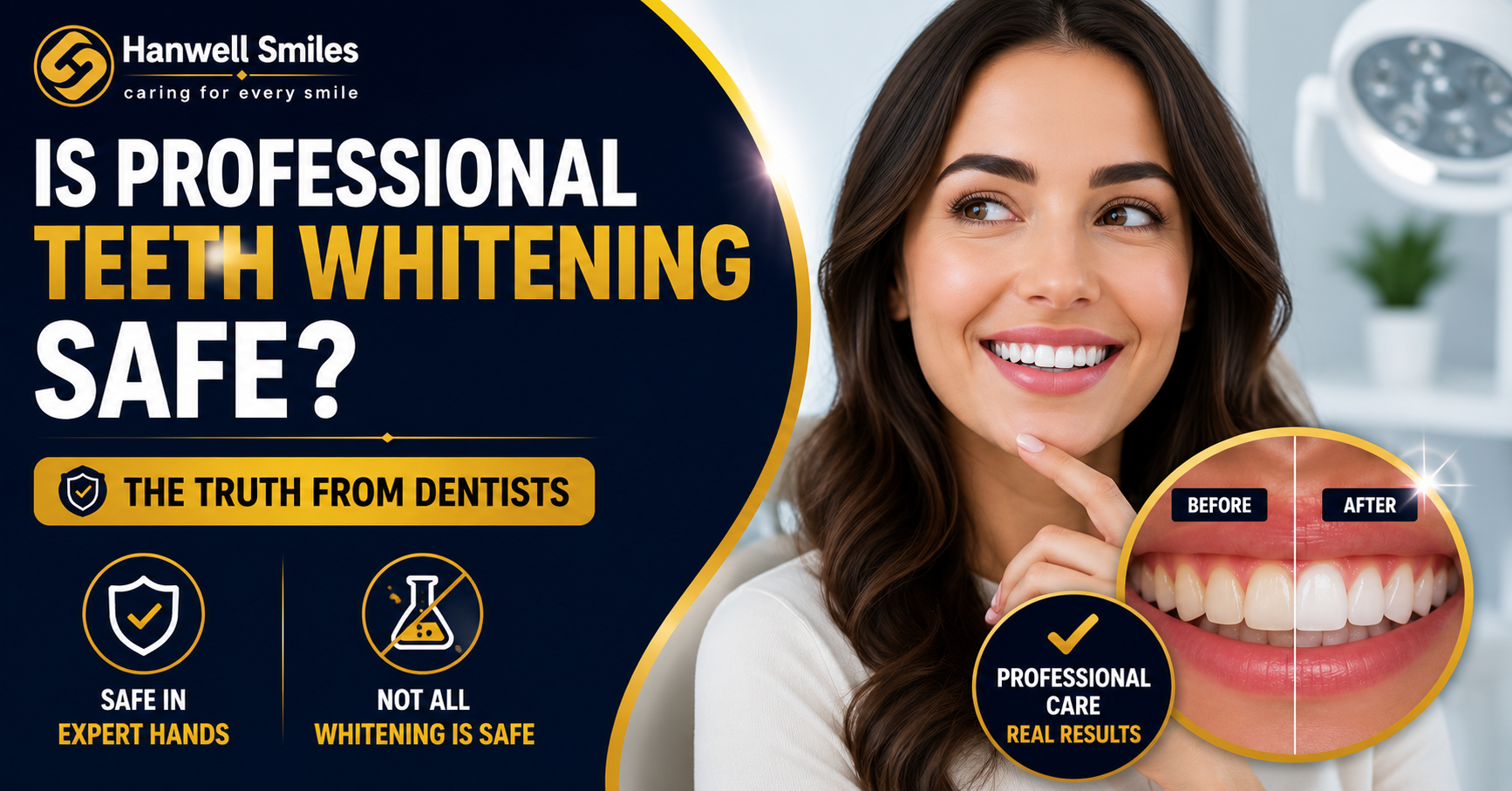
Is Professional Teeth Whitening Safe? What Dentists Don't Tell You (But We Will)
GDC Registered Dentist – CQC Registered – Hanwell Smiles
You’ve decided to whiten your teeth. But before you book that appointment or order that online kit, you’re wondering the question everyone’s too embarrassed to ask:
So what's the truth?
Quick answer: Here’s that what most dentists won’t tell you in plain language: Professional teeth whitening, when done correctly, is entirely safe. DIY whitening, by contrast, carries genuine risks. Let me explain the science, the reality, and exactly how to protect yourself.
Is professional teeth whitening safe?
Yes, when performed by a qualified dentist.
Is at-home DIY whitening safe?
Not reliably — risks of gum damage, enamel harm, and severe sensitivity are genuine.
The difference: Professional whitening is monitored, protective, and scientifically controlled. DIY whitening is none of these things.
Before we talk about safety, you need to understand the actual chemistry at Hanwell Smiles Guide.
How Teeth Get Stained?
Tooth color comes from the inner layer (dentin). Dentin’s natural color ranges from light yellow to darker brown depending on genetics.
Over time, stains accumulate in two ways:
- Extrinsic staining (surface stains)
- Coffee, tea, red wine, tobacco
- Build-up on the outer enamel surface
- Typically removable with professional cleaning alone
- Intrinsic staining (internal stains)
- Particles embedded inside the enamel and dentin
- Caused by age, medication (like tetracycline), fluorosis, or internal bleeding
- Require bleaching to lighten
Teeth whitening products target intrinsic stains by using hydrogen peroxide (or carbamide peroxide) to break apart the chemical bonds holding stain molecules together.
How Bleach Works Chemically?
When hydrogen peroxide contacts tooth structure:
- Penetration: Peroxide molecules diffuse through enamel into dentin
- Oxidation: Oxygen radicals attack stain molecules (chromophores)
- Breaking: Stain molecules split into smaller, colorless compounds
- Lightening: The tooth appears whiter because stain molecules are gone
This process is entirely reversible. Whitening doesn’t permanently change tooth structure — it temporarily alters pigment molecules. When treatment stops, no permanent chemical change has occurred.
This is critical: Whitening ≠ damaging. It’s a chemical change, not a structural one.
According to the General Dental Council (GDC), teeth whitening is a dental procedure and must only be carried out by a registered dental professional or under their prescription. Beauty salons and non-dental providers offering whitening are acting illegally — and risking your oral health.
Professional Whitening: Safety Mechanisms Built In
Here’s why professional whitening is safe:
Before bleach ever touches your teeth, we apply professional-grade barriers:
- Gum protection:
- Liquid dam applied to gum line (hardens into a seal)
- Creates a physical barrier between bleach and soft tissue
- Removed after treatment
- Result: Zero bleach contact with gums
- Lip protection:
- Cheek retractors position your lips away from teeth
- Prevents accidental contact with bleach
Why this matters:
Bleach is caustic. It will burn gum tissue if it contacts it directly. Professional barriers eliminate this risk entirely. DIY kits have no such barriers — so if a strip shifts or bleach leaks, your gums are vulnerable.
Professional products use 35–40% hydrogen peroxide.
- This sounds high, but it’s specifically chosen because:
- High enough to be effective (results in 60 minutes)
- Not so high that it causes tissue damage (unlike 50%+ industrial bleach)
- Applied for limited time (10–15 minutes per cycle)
- pH-controlled (buffered so it’s not caustic)
DIY kits use 3–10% concentration and are often unsupervised — meaning users may apply them for hours, exceeding safe exposure limits.
You can signal discomfort anytime: Treatment adjusts accordingly
- During professional whitening, the dentist is literally watching you:
- Every 10 minutes: Progress checked, sensitivity assessed
- If sensitivity develops: We pause, apply protective compounds, continue when comfortable
- If gums show irritation: We stop immediately and apply healing gel
With DIY kits, there’s no one watching. You could be causing damage and not know it.
After treatment, you don't just leave. We apply:
- Fluoride treatment: Strengthens enamel post-whitening, re-mineralizing microscopic pores opened during bleaching
- Sensitivity-relief compounds: If sensitivity developed, we apply potassium nitrate (proven to reduce sensitivity within minutes)
- Clear instructions: Exactly what to avoid for 48 hours (cold foods, staining foods, acidic drinks)
DIY kits typically end with: “You’re done, good luck.”
The Real Side Effects (Honest Assessment)
Side Effect #1: Tooth Sensitivity
Let me be transparent: professional teeth whitening does have potential side effects. They’re just manageable and temporary.
- What it is:
Bleach temporarily opens microscopic pores in enamel. These pores remain open for 24–48 hours after treatment. During this window, temperature changes (cold water, ice cream) stimulate the nerve inside the tooth, causing a sharp, brief pain. - Severity:
- Mild (60% of patients): Slight tingling, easily managed
- Moderate (30% of patients): Noticeable discomfort for 24 hours
- Severe (10% of patients): Significant pain, requires symptom management
- Duration:
24–72 hours in most cases. Rarely persists beyond 1 week. - How to manage it:
- Use sensitivity-relief toothpaste (apply before bed post-treatment)
- Avoid cold foods/drinks for 48 hours
- Don’t brush aggressively for 48 hours
- Use a soft-bristled toothbrush
- If severe, contact your dentist (we can apply additional relief treatments)
- Why professionals minimize this:
We apply protective compounds during treatment if sensitivity develops. This is why professional sensitivity is typically mild — we stop it before it becomes severe.
With DIY kits, there’s no early intervention. Sensitivity can worsen unchecked.
Side Effect #2: Gum Irritation
- What it is:
If bleach contacts gum tissue (despite barriers), soft tissue inflammation results. - Severity:
- With professional barriers: Essentially zero (barriers prevent contact)
- Without barriers (DIY): Ranges from minor irritation to severe burns
- Duration:
If it occurs, typically resolves within 24–48 hours. - Real talk:
I’ve never seen gum damage from professional whitening because we prevent bleach-gum contact with barriers. I’ve seen plenty from DIY kits where barriers didn’t exist or failed.
Side Effect #3: Enamel Sensitivity (Long-Term)
This is the concern that gets hyped up online.
- The actual science:
Professional whitening does not damage enamel. It temporarily opens pores, but enamel structure remains unchanged. Once re-mineralization occurs (24–48 hours), pores close and enamel integrity is restored. - Research backing this:
A 2014 study in the Journal of Dental Research examined teeth after whitening under an electron microscope. Finding: “No structural changes to enamel were detected after professional whitening.” - However:
If you whiten excessively or use poor-quality products for extended periods, you could cause enamel erosion. This is rare with professional treatment but common with DIY overuse.
Side Effect #4: Temporary Tooth Whiteness Instability
- What it is:
Immediately after bleaching, teeth are in a “post-bleach” state where they’re slightly more porous. Over the next 24–48 hours, enamel re-hardens and the whitest shade is locked in. - What this means:
Don’t judge your results immediately. Wait 48 hours for full stabilization.
This isn’t a safety issue, just something to know.
Important: If you have crowns, veneers, bridges or white fillings on visible teeth, discuss this with your dentist before whitening. Whitening gel does not change the colour of restorations — so existing dental work may become more noticeable if your natural teeth whiten around them.
The REAL Risk: DIY Whitening
Here’s where I need to be blunt: DIY whitening carries genuine safety risks that professional whitening doesn’t.
Risk #1: Gum Burns (DIY Strips)
- What happens:
Over-the-counter strips aren’t custom-fitted. They’re one-size-fits-all. This means:- Strips shift during wear
- Bleach leaks onto gum tissue
- Soft tissue burns result
- Severity:
I’ve seen patients with severe gum burns requiring professional treatment:- Red, swollen, painful gums
- Difficulty eating or speaking
- Lasts 1–2 weeks
- Professional treatment cost: £150–£250 to manage
- From what:
A £20 strip that was supposed to save money.
Risk #2: Enamel Damage (Overuse)
- What happens:
DIY users often think “if a little is good, a lot is better.” They:- Use strips longer than recommended
- Use them more frequently than safe
- Stack multiple methods (strips + toothpaste + trays)
- Don’t monitor for damage
- Result:
Enamel gradually erodes. Once enamel is gone, it’s gone forever. You’re left with:- Permanent sensitivity
- Accelerated decay (enamel protects from cavity-causing bacteria)
- Yellowing (the underlying dentin shows through eroded enamel)
- Costly restorative treatment (£1,000+)
Risk #3: Severe, Persistent Sensitivity
- What happens:
DIY users, lacking professional guidance, sometimes cause sensitivity that doesn’t resolve. - Why:
- Bleach concentration too high for too long
- Application to sensitive areas (root surfaces)
- Pre-existing enamel thinness not recognized
- No protective treatment applied
- Result:
Teeth remain permanently sensitive to cold, requiring:- Lifelong sensitivity toothpaste
- Dietary restrictions
- Root surface treatment (£200–£400)
- In severe cases, root canal treatment (£300–£500)
Risk #4: Uneven Whitening
- What happens:
DIY methods don’t whiten evenly:- Edges stay yellow
- One tooth whiter than others
- Patchy appearance
- Natural-looking smile becomes unnatural-looking
- Then what:
Patient comes to a professional to “fix” the uneven whitening, paying £350 for professional treatment on top of what they wasted on DIY.
Who Should Be Extra Cautious With Whitening?
Certain people carry higher risk and need professional guidance (or should skip whitening):
People with Existing Enamel Erosion
- Already have enamel wear (from acid reflux, aggressive brushing, acidic diet)
- Whitening can accelerate erosion
- Solution: Professional assessment first; whitening only if safe
People with Existing Sensitivity
- Teeth already sensitive to cold
- Whitening can worsen sensitivity
- Solution: Pre-treat with desensitizing compounds; use lower concentration
People with Thin Enamel
- Some people naturally have thinner enamel
- Visible dentin underneath makes teeth appear yellow
- Reality: Whitening won’t help if the problem is thin enamel, not staining
- Solution: Professional evaluation to determine if whitening will actually work
People with Gum Disease
- Receding gums expose root surfaces
- Bleach on exposed roots = severe sensitivity + damage
- Solution: Treat gum disease first; then whitening only if safe
People with Dental Work (Crowns, Fillings, Veneers)
- These materials don’t whiten
- Whitening natural teeth but not restorations = color mismatch
- Solution: Whiten natural teeth first, then match restorations if needed
Pregnant or Nursing Women
- Limited research on whitening safety in pregnancy
- To be cautious, we typically recommend waiting until after pregnancy/nursing
- Solution: Consult your dentist; usually better to wait
Professional Whitening vs. DIY: Safety Comparison
| Factor | Professional Whitening | DIY Whitening Strips | DIY Custom Online Kits |
|---|---|---|---|
| Gum protection | ✅ Yes (barriers applied) | ❌ No | ⚠️ Sometimes (hit-or-miss) |
| Monitoring | ✅ Yes (real-time) | ❌ No | ❌ No |
| Emergency support | ✅ Yes (call anytime) | ❌ No | 📧 Email support only |
| Results consistency | Excellent | Poor | Variable |
| Gum burn risk | Essentially zero | High (15–20% of users) | Moderate (10–15% of users) |
| Enamel damage risk | Minimal (professional protocols) | Moderate (overuse risk) | Moderate (lack of professional guidance) |
| Sensitivity risk | Low (managed during treatment) | Moderate–High (unmanaged) | Moderate–High |
| Long-term enamel sensitivity | Rare (with proper aftercare) | Common (10–15% develop long-term sensitivity) | Moderate (5–10%) |
| Cost if something goes wrong | Usually covered within treatment | £150–£500 for professional repair | £100–£500 for professional repair |
The Research: What Science Actually Says
- Study 1: Safety Profile of Professional Whitening
- Source: Operative Dentistry (2015)
- Finding: Professional whitening, when used per guidelines, shows no adverse effects on enamel or dentin structure
- Conclusion: Professional whitening is safe
- Study 2: DIY Whitening Risks
- Source: Journal of the American Dental Association (2017)
- Finding: 23% of DIY whitening users reported adverse effects (sensitivity, gum irritation, enamel damage). Only 3% of professional whitening users reported any adverse effects
- Conclusion: DIY carries significantly higher risk
- Study 3: Long-Term Safety
- Source: International Journal of Aesthetic Dentistry (2018)
- Finding: Teeth whitened professionally and maintained with proper protocols showed no long-term damage after 5 years
- Conclusion: Professional whitening is durable and safe long-term
Red Flags: When NOT to Whiten (Professional Advice)
Even professional whitening isn’t appropriate for everyone.
Here’s when we’d recommend against whitening:
If enamel is already significantly worn, whitening will worsen sensitivity without improving appearance. Better option: bonding or crowns.
Whitening near inflamed gums risks further damage. Treat gum disease first; whiten later.
Bleach will penetrate cracks, causing sensitivity and internal damage. Restore teeth first; whiten after.
Rare, but some people react to hydrogen peroxide. If you know this, whitening isn't an option.
If you expect your teeth to become unnaturally bright white, or if you have intrinsic yellowing that won't respond well to bleaching, we'd counsel against treatment.
What to Expect During Professional Whitening (Safety Breakdown)
Here’s the actual process at a professional clinic like Hanwell Smiles:
- Before Treatment
- Consultation (10 mins): We assess risk factors, discuss expectations, explain what to expect
- Shade check: Current shade measured and photographed
- Sensitivity evaluation: Ask about existing sensitivity; apply protective coating if needed
- Barrier application (5 mins): Gum and lip protection applied; you’re isolated from bleach
- During Treatment
- Bleach application (30 mins): Three 10-minute cycles
- First cycle: Bleach applied; light activated (if used)
- Minute 10: Progress checked; if sensitivity, protective treatment applied
- Bleach removed; mouth rinsed
- Repeat 2 more times
- Monitoring throughout: Dentist checks in every 10 minutes; you can signal discomfort anytime
- After Treatment
- Fluoride application (5 mins): Strengthens enamel
- Sensitivity relief (if needed): Potassium nitrate applied
- Aftercare instructions: Exactly what to do for next 48 hours
- Result documentation: Final shade photographed
- After Treatment
- Safety Throughout
- Barriers prevent bleach-tissue contact: ✓
- Safety Throughout
- Protective compounds applied if sensitivity develops: ✓
- Professional monitoring ensures safety: ✓
- Rapid intervention if anything uncomfortable: ✓
Post-Treatment: How to Maintain Safety and Results
After professional whitening, you’re responsible for:
- First 48 Hours (The Whitening Window)
- Avoid staining foods/drinks (coffee, tea, red wine, curry)
- Avoid very cold foods (sensitivity risk)
- Don’t smoke
- Use sensitivity toothpaste if needed
- Use a soft-bristled toothbrush
- Next Week
- Continue sensitivity toothpaste if needed
- Maintain brushing routine (don’t over-brush)
- Normal diet is fine after 48 hours
- Brush gently near gum line (sensitivity possible)
- Ongoing Maintenance
- Good oral hygiene (prevents staining, maintains health)
- Regular dental checkups (catch problems early)
- Avoid excessive staining foods/drinks (if you want results to last)
- Touch-up treatments every 6–12 months (maintain brightness)
The Bottom Line: Is Professional Teeth Whitening Safe?
Yes. Professional teeth whitening, performed by a qualified dentist, is safe and effective.
DIY whitening? Not as safely managed. Risks of gum damage, enamel wear, and persistent sensitivity are genuinely higher.
- The reason professionals are safer:
- Protective barriers prevent damage before it starts
- Proper concentration + limited exposure = optimal results without harm
- Real-time monitoring catches problems immediately
- Professional aftercare manages any sensitivity
- Emergency support is available if issues arise
Most importantly: Professional whitening is monitored by someone trained to recognize and prevent problems. DIY whitening is unmonitored, unprotected, and risky.
Ready for Safe, Professional Teeth Whitening?
If you’re ready to whiten your teeth safely, book your professional whitening consultation at Hanwell Smiles →
We’ll:
- Assess your individual risk factors
- Explain exactly what to expect
- Answer every safety question you have
- Perform treatment with professional-grade protocols
- Monitor you throughout
- Provide aftercare support
No hidden risks. No guesswork. Just safe, professional whitening.
FAQ’s:
Yes. When performed by a qualified, GDC-registered dentist, professional teeth whitening is safe. Protective gum barriers, controlled bleach concentration, and real-time monitoring prevent damage that DIY kits can’t avoid.
No. Professional whitening doesn’t structurally damage enamel — it temporarily opens microscopic pores that close again within 24–48 hours. Enamel erosion is mainly linked to DIY overuse, not professional treatment.
Most sensitivity lasts 24–72 hours and resolves on its own. Dentists apply fluoride and potassium nitrate after treatment to reduce discomfort, which DIY kits don’t offer.
Yes. Studies show 23% of DIY whitening users report side effects like gum burns or sensitivity, compared to only 3% of professional whitening patients, mainly due to unsupervised use and lack of gum protection.
People with active gum disease, severe enamel erosion, cracked teeth, peroxide sensitivity, or who are pregnant should avoid whitening until a dentist confirms it’s safe for them.
Professional whitening typically costs less long-term than repairing DIY-related damage, which can range from £150 for gum burns to over £1,000 for enamel restoration.
Book Your Teeth Whitening Consultation
Ready to transform your smile without the DIY damage?
Schedule your professional teeth whitening appointment at Hanwell Smiles →
Get Teeth Whitening Consultation Today
Hanwell Smiles — Teeth Whitening Dental Care in Hanwell.